Fighting Back by Kayla Harrison
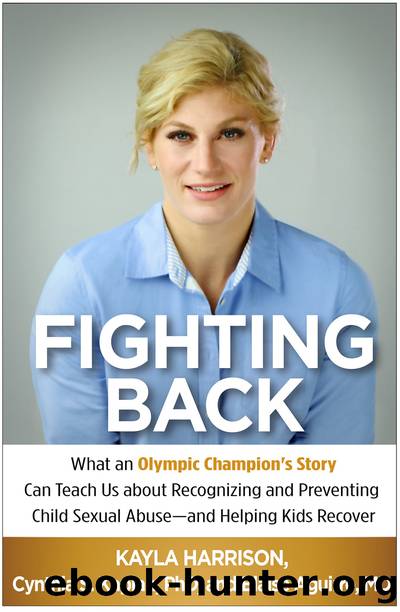
Author:Kayla Harrison [KAYLA HARRISON, Cynthia S. Kaplan, PhD, and Blaise Aguirre, MD]
Language: eng
Format: epub
ISBN: 9781462535897
Publisher: Guilford Publications
WHAT ABOUT VICTIMS WHO ARE NOW ADULTS?
We see many young adults in our practices who are dealing with issues related to sexual assault that were disclosed only after they had turned 18. Their families often donât know what adversities transpired earlier in their lives, and these victims may or may not want to disclose to their families at this juncture. In light of the reality that the reporting mandate does not extend to child sexual abuse discovered or disclosed once the child has become an adult, clinicians are not required to report an allegation of child abuse unless there is a compelling reason to believe other children may be at risk of abuse by the same perpetrator (see Statutes of Limitations for Sexual Assault by Brittany Ericksen and Ilse Knech, available from https://tinyurl.com/h5y7ftp, for specifics on state statutes). Does this mean that criminal prosecution is off the table
Not necessarily. For victims who still want to have their day in court, most states have expanded the statute of limitations for childhood sexual abuse so that the clock does not start running for bringing criminal charges until the identity of the alleged abuser is revealed. The statute of limitation in many states used to be 10 years from the time the abuse actually occurred, regardless of when it was formally disclosed. This meant that if a child was abused at the age of 6 and only felt safe enough to file charges once he or she turned 18, the statute of limitations would have expired. In recognition of the common time lag between the occurrence of sexual assault and disclosure, many states have changed their laws so that victims have sufficient time post-disclosure to figure out what, if anything, they want to do about holding their perpetrator accountable.
Many victims are not interested in pursuing a legal option so long after their abuse occurred. Does this mean their recovery suffers from missing their day in court? Many people who choose not to prosecute as adults nonetheless feel reassured to learn that this opportunity is still available. Some choose instead to take informal actions, such as writing their perpetrators letters, arranging to confront them directly, or holding them responsible by finally telling others about this personâs abusive behaviors, which may often be equally satisfying.
Therapy that child and adolescent victims receive is also available to adults. Such therapy with a trained clinician can often provide a forum for adults who disclose their sexual abuse to do the emotional processing they might not have done before and, via this process, make informed decisions about if and in what ways they want to hold the perpetrator accountable.
Download
This site does not store any files on its server. We only index and link to content provided by other sites. Please contact the content providers to delete copyright contents if any and email us, we'll remove relevant links or contents immediately.
Unwinding Anxiety by Judson Brewer(73059)
The Art of Coaching by Elena Aguilar(53274)
The Fast Metabolism Diet Cookbook by Haylie Pomroy(21149)
Rewire Your Anxious Brain by Catherine M. Pittman(18658)
Healthy Aging For Dummies by Brent Agin & Sharon Perkins RN(17048)
Talking to Strangers by Malcolm Gladwell(13376)
The Art of Thinking Clearly by Rolf Dobelli(10492)
Mindhunter: Inside the FBI's Elite Serial Crime Unit by John E. Douglas & Mark Olshaker(9347)
Crazy Rich Asians by Kevin Kwan(9297)
The Compound Effect by Darren Hardy(8978)
Tools of Titans by Timothy Ferriss(8403)
Periodization Training for Sports by Tudor Bompa(8278)
Becoming Supernatural by Dr. Joe Dispenza(8225)
Wonder by R. J. Palacio(8118)
Crystal Healing for Women by Mariah K. Lyons(7934)
Bodyweight Strength Training by Jay Cardiello(7920)
Change Your Questions, Change Your Life by Marilee Adams(7788)
Therapeutic Modalities for Musculoskeletal Injuries, 4E by Craig R. Denegar & Ethan Saliba & Susan Saliba(7723)
Nudge - Improving Decisions about Health, Wealth, and Happiness by Thaler Sunstein(7712)
